Showing posts with label Evaluation methods. Show all posts

Sunday, August 14, 2011

Week Three: Methods of evaluation and projects

Snow at home in August 2011 by bronwynannh
Well it is easy enough to see that I will be playing in the snow this week. Luckily all the neighbours' wee lambs are tucked up safely in their big shed. My sheep are playing the hungry card, poor things.

Progress reminder
By now you should have your introduction on your blog and have contributed to the Activity two - evaluation and quality discussion forum.

What's on this week?
 This week we are looking at methods of evaluation - needs analysis, usability, effectiveness, impact and maintenance - described by Professor Tom Reeves and Professor John Hedberg in their 2003 book on evaluation - Interactive Learning Systems Evaluation. Englewood Cliffs: Educational Technology Publications - Chapter Three. Also, on Google books is a preview of the book. The information is summarised in the different Resources accompanying Activity Three.

Online meeting
 Evaluation methods will be discussed in the online meeting this week: 16 August - 19:00–20:00 on Wimba. Make sure you test the link well in advance of the session. Please take note of the telephone call number and student pin code so you can enter via your telephone if all else fails. Access via eMit - Online meetings/Wimba Classroom. Please text me if you have difficulties (contact details can be found via the Lecturer link on eMit).

Activity Three
The information about this week's activity and the resources accompanying it can be found via Course Activities/Evaluation Methods.
  • Use the resources to find out about different types of evaluation.
  • Explore the literature about evaluation which is relevant to your context. A lot of material is compiled in the References section of the wiki, and you may also wish to find your own.
  • Post a summary of the key ideas to your blog.
  • Examine the range of potential evaluation projects on offer (a link to them is available on eMit in the Projects discussion forum), and either choose one of these or advertise your own.
  • Organise yourselves into groups for the evaluation projects - use the Projects discussion forum to join a project group and to negotiate your methods of working collaboratively.
I hope you find a project to suit you. If you have an idea for your own evaluation project, make sure you email me with the overview - using a similar structure to the one used for the list of potential projects. This information will be used to inform your evaluation plan. Have a great week, and I hope to meet lots of you on Tuesday evening.

Monday, August 16, 2010

Week Four: Methods of evaluation

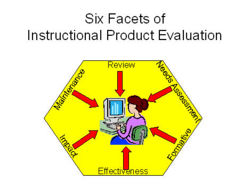
Image: Diagram from a presentation by Professor Tom Reeves
Your explorations of the evaluation tasters and the Evaluate This exercise have hopefully helped you to understand that there are different reasons for doing evaluation. The evaluation type or method you choose for your project will depend on why you are doing the evaluation. During this topic over the next week, you will be investigating both formative and summative evaluation methods such as: needs analysis, usability, effectiveness, impact and maintenance evaluation.  These methods are outlined in one of this week's activities - the presentation by Professor Tom Reeves - it depicts "Six Facets of Instructional Product Evaluation. Review. Effectiveness. Maintenance. Formative. Needs Assessment. Impact. Development Activities".
  Remember evaluation is generally done as a measure of quality.
 
Diamond (Pink) by Clagnut
On the email forum we will be discussing different types of evaluation, taking into account the reasons for doing the different evaluations.  Sometimes people who do not fully understand the processes of evaluation, jump straight in and talk about doing surveys or interviews, which is a common mistake; these are data collection methods, and only a small part of a bigger evaluation process.

If the broader evaluation method, that is, whether it is formative or summative is discussed and planned thoroughly, very useful information can be obtained.  If you are clear about the phase of eLearning to be evaluated, the method to be used will become clear. For example, if eLearning is in the early planning stages, a needs analysis will be appropriate. However, if an eLearning course or resource has already been developed and has been launched as a finished product, then an effectiveness evaluation is more relevant.

As you have probably already realised since viewing the presentation -  Why is evaluation so important? - evaluation is an ongoing process from the ideas phase right through design, development and implementation. This concept is reiterated in this week's topic with a more detailed explanation about evaluation and the ADDIE model on an audio I have made. There are lots of activities this week, and they are listed in the Methods section of the course wiki.  They will prepare you for the next phase - planning your evaluation project so buckle yourself in for the ride.

First of all though - would you eat these pizzas? Watch and decide for yourself.